 Home
Home
rOm
Quest
Glossary
Random
Page
Search
Site
Lush
Sim
Class
Subject
Images
Help
FAQ
Sign
Up
Log
In
WANTED: Individual or team to take over this project. I'm in my 70's and want to put my feet up. Contact details in footer.
Compare Switch Types
-
BJT switches are fast and the transistors are not expensive. A minus point is the current needed to operate the switch.
-
MOSFETS are even faster but they cost more. A plus point is the minute current needed to operate the switch - nearly zero.
-
OP-Amp comparators are slow, more expensive, but much more sensitive to input voltage changes.
-
Logic GATE switches are fast and cheap but not very sensitive to small input voltage changes.
-
Mechanical switches are less reliable due to the moving parts.
-
Electromagnetic relays are less reliable due to the moving parts.
-
Mechanical switches and relays can switch high voltages and currents and also alternating current.
A small base current is used to switch a much larger collector current.
Bipolar Junction Transistor Switches - OK for Low Power
SIMULATION
-
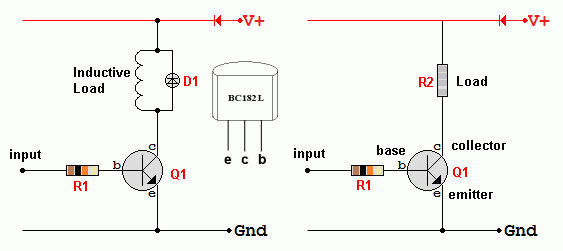
Here is a switch or transducer driver based on an NPN bipolar junction transistor.
-
This is also known as a common emitter switch.
-
A small base (b) current controls a much larger collector (c) current supplying the transducer.
-
A high logic level in the input will switch on the bipolar junction transistor.
-
To calculateR1 R1 <= RL x hFE R1 should be less than or equal to the current gain times the load resistance.
-
R1 limits the base current to a few milliamps
-
Q1 is an NPN transistor. For example a BC182L with a current gain of about 300
-
R2 is the load. This could be a bulb, an LED, a relay, a small motor, a buzzer and so on.
-
D1 is only needed if the load is inductive. Inductive loads are electromagnetic devices such as motors, relays and some buzzers.
When the current through an inductor is turned off suddenly, a large Back EMF is produced.
This could be enough to destroy the transistor.
By adding the diode, the current through the inductor can die away gradually (by flowing through the diode).
This prevents the large back EMF.
-
When the transistor is saturated (fully turned on), the collector current depends only on the load resistance and the power supply voltage.
-
When the transistor is cut off (fully turned off), Vce = Vs.
-
If VIN is less than 0.7 V
-
VCE is equal to the power supply voltage.
-
VBE is equal to VIN.
-
The potential difference across the load is zero.
-
If VIN is more than 0.7 V
-
VBE is equal to 0.7V.
-
VCE is approximately zero.
-
The potential difference across the load is approximately equal to the power supply voltage.
-
For efficient switching, the transistor should be saturated.
-
When saturated, increasing the base current has no effect on the collector current.
-
If the base current is too small and the transistor is not saturated and IC = hFE IB
-
hFE is the current gain of the transistor.
Current Gain
-
Current Gain hFE = Ic / Ib Values from 10 to 500 are common.
Try this Flash simulation.
Alternative Circuits
-
Use a MOSFET. This switches faster. Bigger currents can be handled. A minute input power is needed to operate the switch. The MOSFET is voltage operated. This is often an advantage.
-
Use a relay. This is mechanical, slow and relatively unreliable but enormous currents can be switched. Alternating currents can be switched too.
-
Use a thyristor or a triac.
Estimating Component Values
Here is an example ...
-
The load resistance is 600 Ω
-
The load current is 20mA.
-
The transistor current gain is at least 200.
-
To get 20mA in the collector, 20/200 mA base current is needed = 0.1 mA
-
In the 12 Volt circuit above, the base resistor connected to 12V would need to be ...
-
R = V / I
-
R = 12 / 10-4 = 120 kΩ A 100 kΩ resistor would be OK.
-
You should now notice that the base resistor is 200 times the load resistor because the current gain is 200. This gives a quick way to estimate what base resistor to use.
Thermal Stability and Run-Away
-
When a bipolar transistor heats up, its current gain increases.
-
This causes the current to increase.
-
This makes it hotter.
-
In a poorly designed circuit, this is a vicious cycle and can lead to thermal run-away and the destruction of the transistor.
-
NEGATIVE FEEDBACK helps to solve the problem.
-
Increasing current is used to shut down the device, returning the current back to a safe level.
Subject Name
Level
Topic Name
Question Heading
First Name
Last Name Class ID
User ID
Question Text
image url
Help Link
Add
Delete
Clone
Edit
Hardness
Help Text
Debug
- You can attempt a question as many times as you like.
- If you are logged in, your first attempt, each day, is logged.
- To improve your scores, come back on future days, log in and re-do the questions that caused you problems.
- If you are logged in, your most recent wrong answers get remembered. This might help you and your teacher to correct your understanding.
- In the grade book, you can delete your answers for a topic before re-doing the questions. Avoid deleting unless you intend re-doing the questions very soon.
